

Before you start
The following requirements must be met within both your Wherobots Organization and AWS account before you can connect to an S3 Tables catalog.Wherobots Requirements
Wherobots Requirements
- An Admin account within a Professional, Innovation, or Enterprise Edition Organization to create catalogs and Cloud Connections.
Wherobots Organization members with the User role can use existing catalogs and Cloud Connections set up by Admins but cannot create new ones. See Organization Roles.
- An existing Cloud Connection to your AWS account, or permission to create one. For more information, see Cloud Connections.
- Your Organization ID, found at cloud.wherobots.com/organization.
AWS Requirements
AWS Requirements
- An AWS account with an existing S3 table bucket. Unlike a general purpose S3 bucket, a table bucket stores Iceberg tables and manages their storage for you, so you don’t supply a separate S3 path.
-
The ARN of the table bucket you want to connect, in the form
arn:aws:s3tables:<region>:<account-id>:bucket/<table-bucket-name>. Find it in the AWS console under S3 → Table buckets. -
Permission to create CloudFormation stacks that provision IAM resources (typically
AdministratorAccess), so Wherobots can set up the Cloud Connection and grant it S3 Tables access. CloudFormation creates the IAM role and policies for you, so you don’t edit them by hand.What CloudFormation provisions
The pre-filled templates create or modify IAM resources on your behalf. The actions they perform typically requireAdministratorAccess:For a complete list of IAM Actions, see Actions defined by AWS Identity and Access Management in the AWS Documentation.
Cloud Connections
Before you can connect to an Amazon S3 Tables catalog, Wherobots needs a Cloud Connection to your AWS account.What is a Cloud Connection?
What is a Cloud Connection?
Manage Cloud Connections
Cloud Connections live in Organization Settings under Cloud Connections, where Admins can create, list, verify, and delete them.- Verify: Confirms Wherobots can assume your IAM role through the two-hop AWS STS
AssumeRolechain. - Delete: Blocked while any storage integration or Glue catalog is still bound to the connection. You must remove any resources bound to that Cloud Connection prior to its deletion.
Connect to the Amazon S3 Tables catalog
Connect your S3 table bucket to your Wherobots Organization in order to read and write to it from your Wherobots workloads. The Data Hub wizard provisions the connection with a CloudFormation stack, so you don’t have to write IAM policies or Spark configs by hand.Open the Add Amazon S3 Tables Catalog wizard
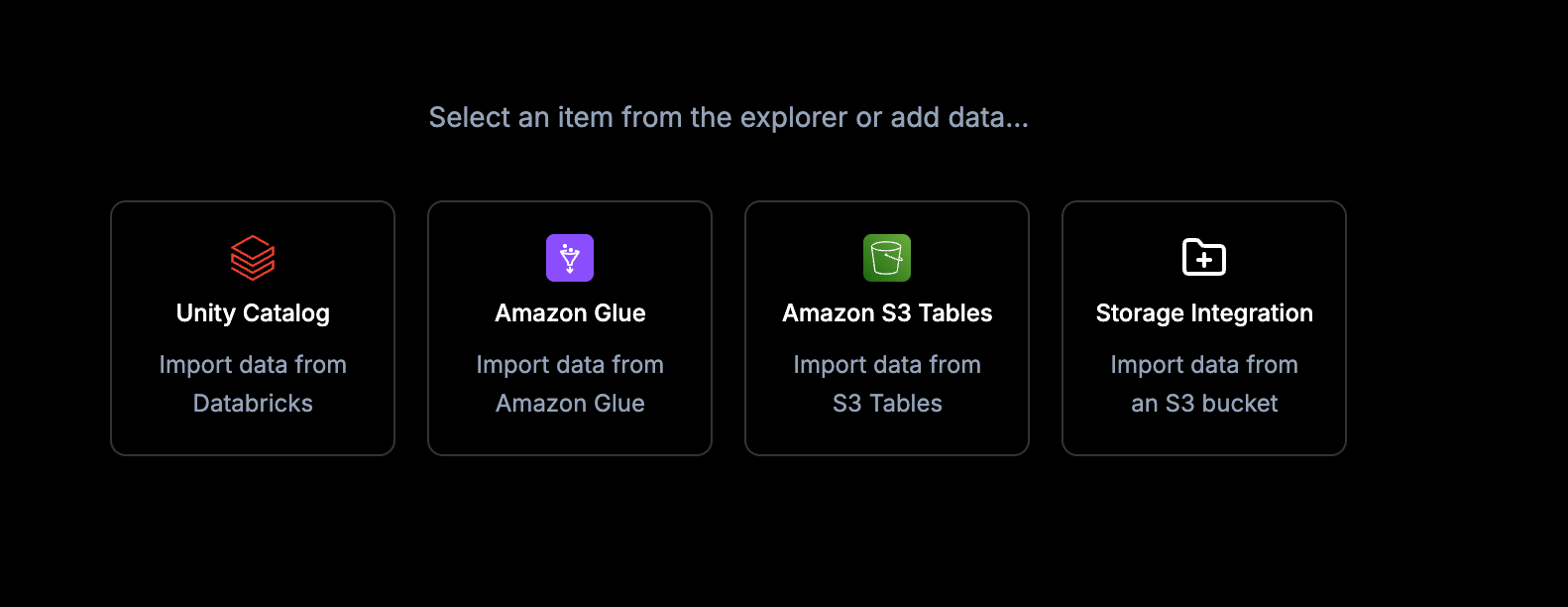
Data Hub add data cards: Unity Catalog, Amazon Glue, and Amazon S3 Tables.
Enter the catalog details
- Name: The name of the catalog in Wherobots.
- This affects the Fully Qualified Name (FQN) used to reference this catalog in Wherobots:
CATALOG_NAME.DATABASE_NAME.TABLE_NAME, whereDATABASE_NAMEis the S3 Tables namespace. - A name can contain any character. But if it includes anything other than letters, numbers, or underscores — such as a space, dash, or period — you must wrap the name in backticks wherever you reference it in the FQN. For example, a catalog named
My-Catalogis referenced as`My-Catalog`.namespace.table.
- This affects the Fully Qualified Name (FQN) used to reference this catalog in Wherobots:
- Table Bucket ARN: The ARN of the S3 table bucket you’re connecting, for example
arn:aws:s3tables:us-east-1:123456789012:bucket/my-table-bucket. The region and AWS account are read from the ARN, so there’s no separate AWS Region or S3 Path field to fill in. - Access level: The level of access Wherobots has to the catalog.
- Choose Read-only to allow Wherobots to read tables in your S3 Tables catalog, but not create or modify them.
- Choose Read-write to allow Wherobots to read, create, and modify tables in your S3 Tables catalog.
- Click Continue.
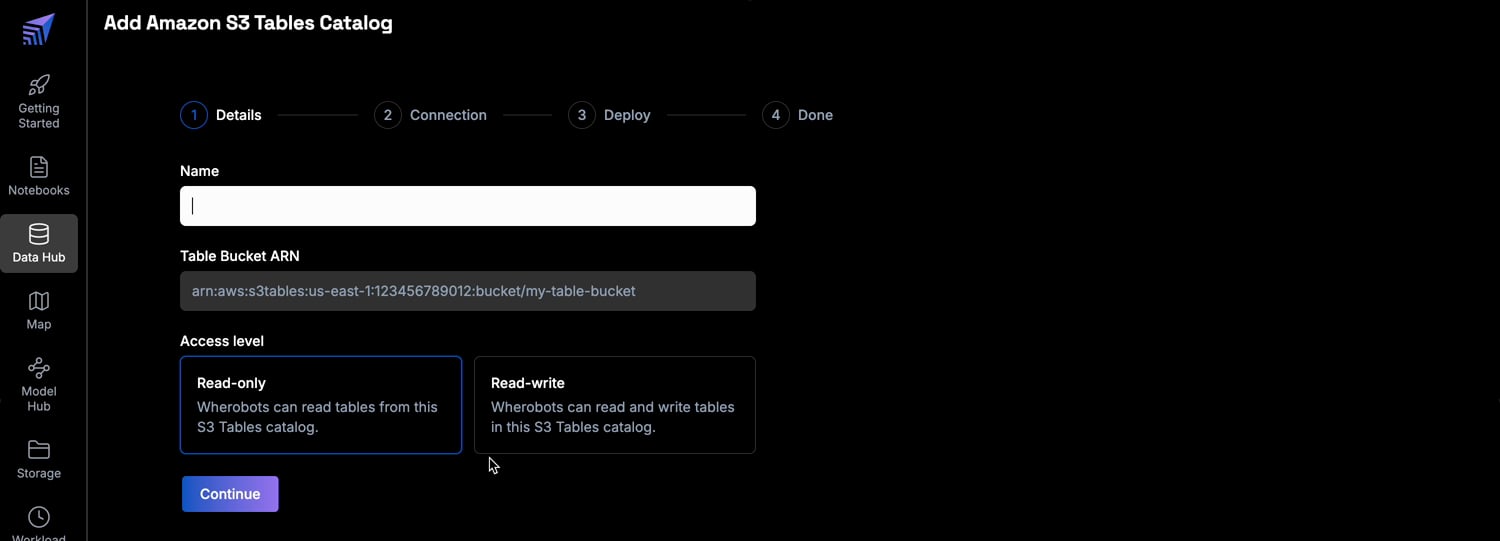
Step 1, Details: name the catalog, then set the table bucket ARN and access level.
Choose a Cloud Connection
Create a new Cloud Connection
Create a new Cloud Connection
Enter the connection details
- Connection Name — a label that identifies the trust relationship in Wherobots.
- AWS Account ID — the 12-digit AWS account you’re connecting to.
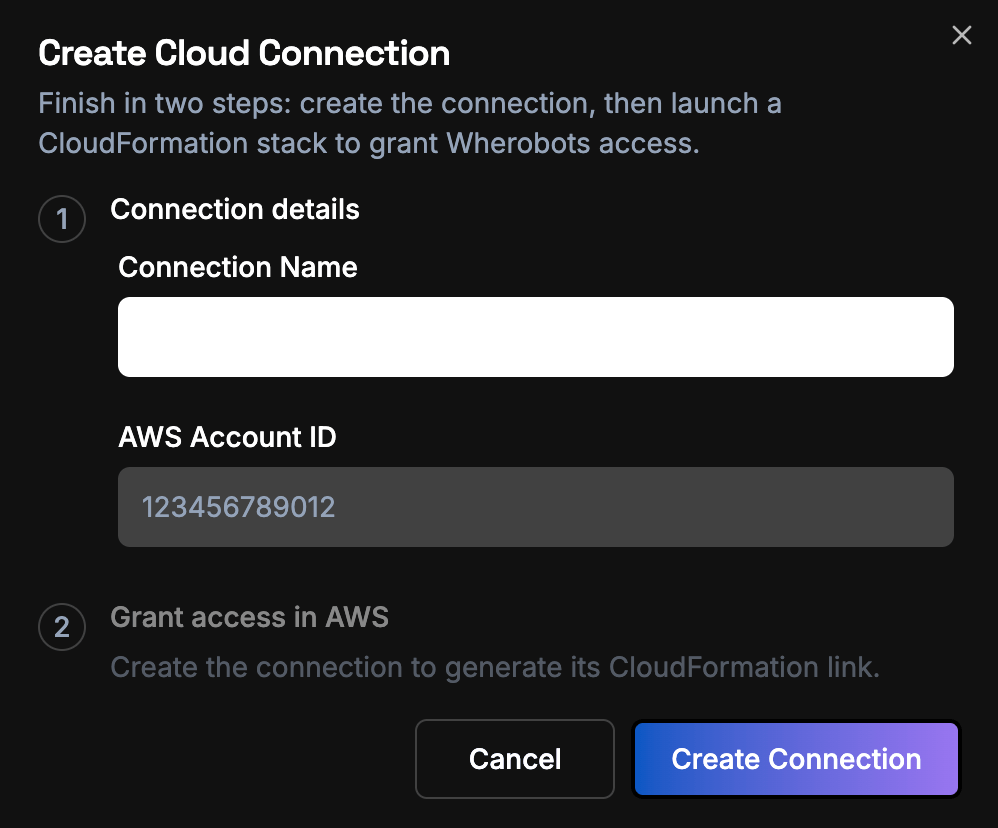
Connection details: name the connection and enter your AWS Account ID.
Grant access in AWS
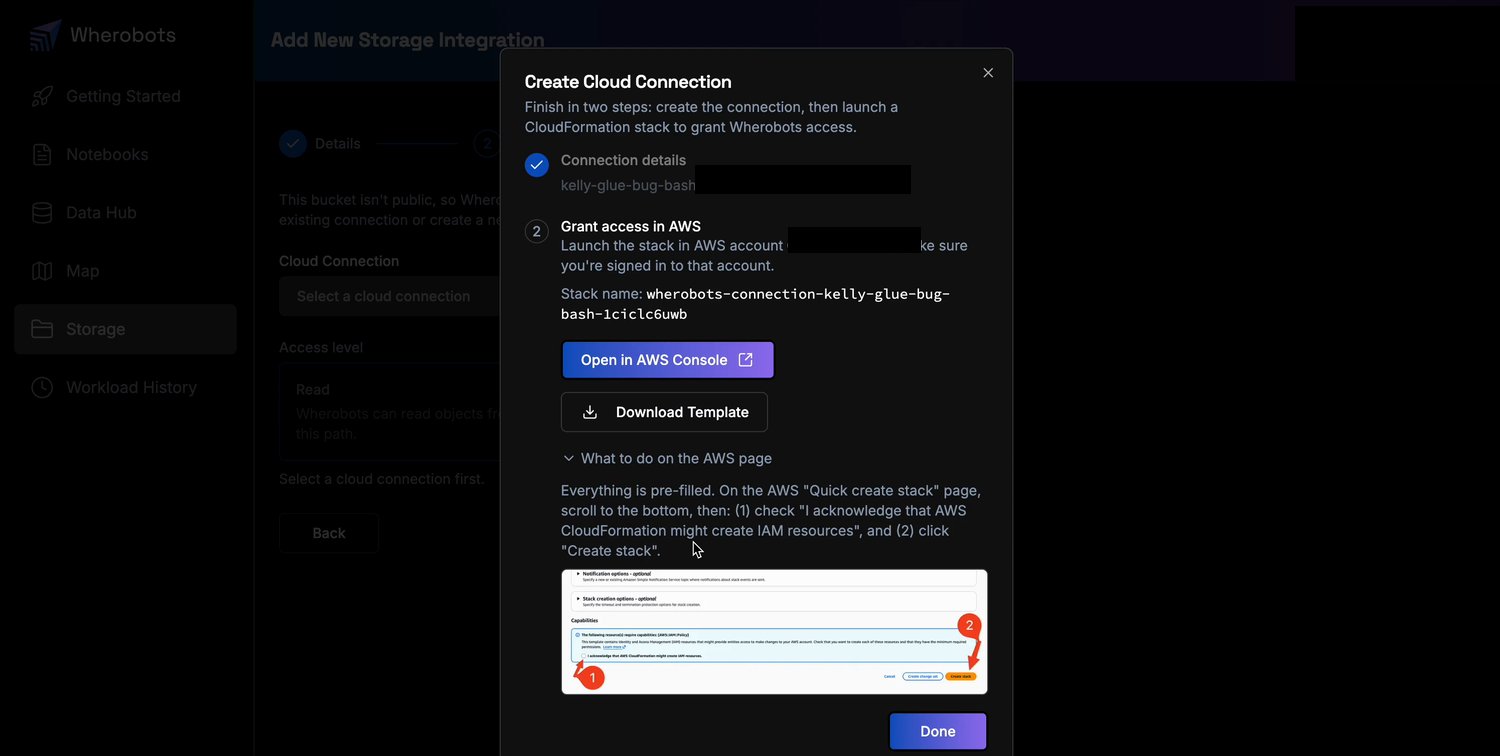
Grant access in AWS: launch the pre-filled CloudFormation stack that creates the Cloud Connection role.
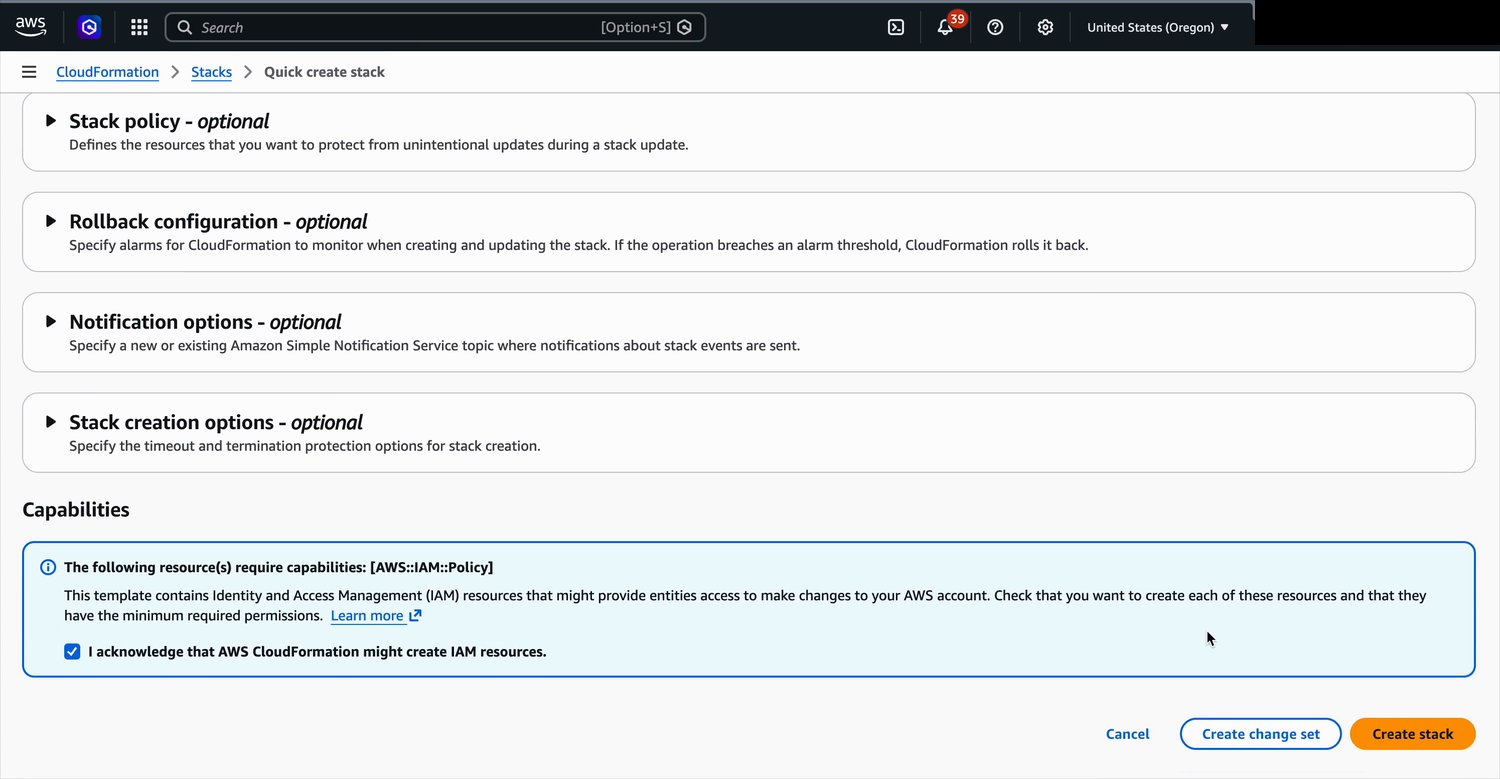
On the AWS Quick create stack page, acknowledge the IAM capability and click Create stack.
Deploy the catalog stack
- Click Open in AWS Console (or Download Template to manually paste it into the AWS CloudFormation console).
- On the AWS Quick create stack page, scroll to the bottom, select I acknowledge that AWS CloudFormation might create IAM resources, and click Create stack.
- Return to Wherobots and click Create catalog.
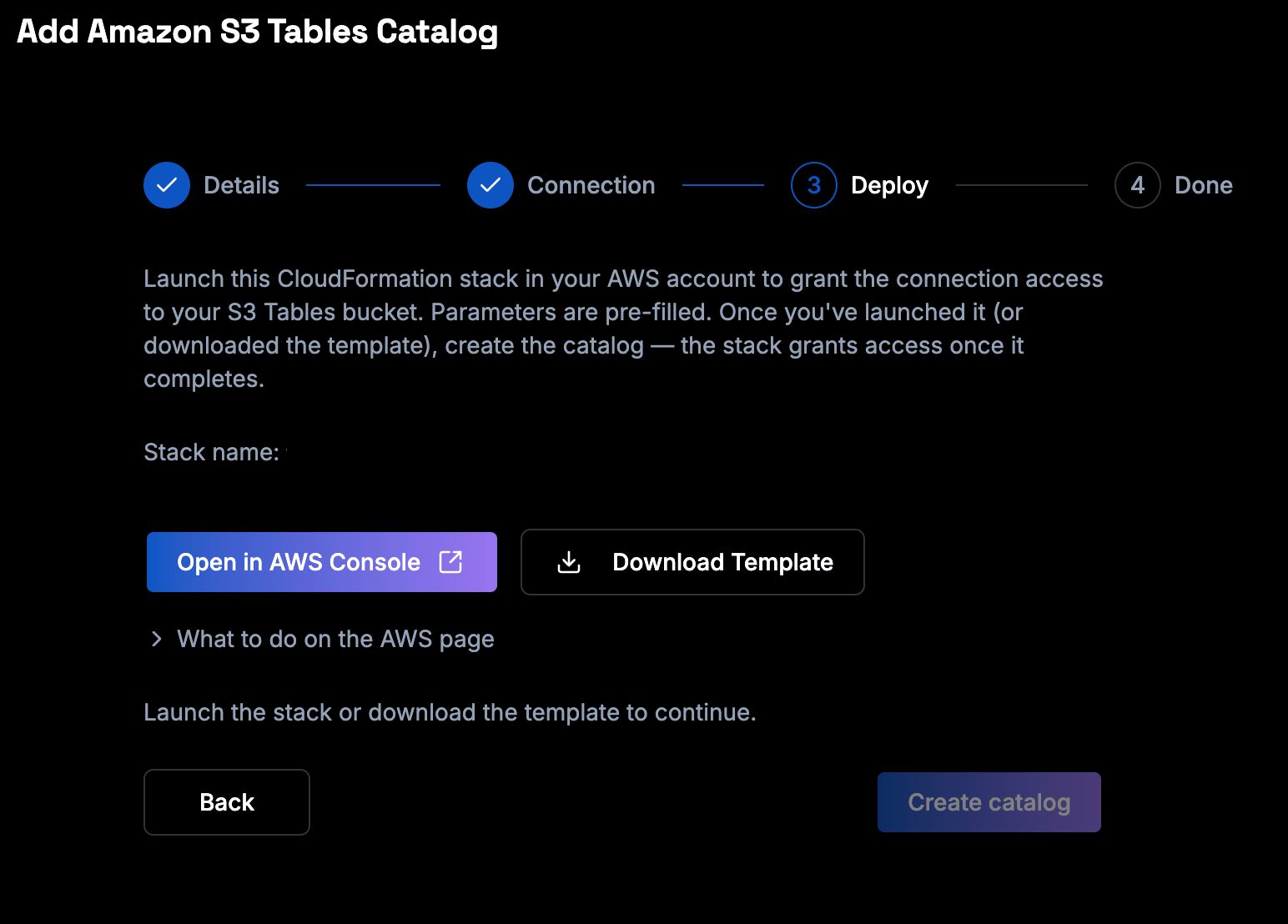
Step 3, Deploy: launch the pre-filled CloudFormation stack, then return to Wherobots to create the catalog.
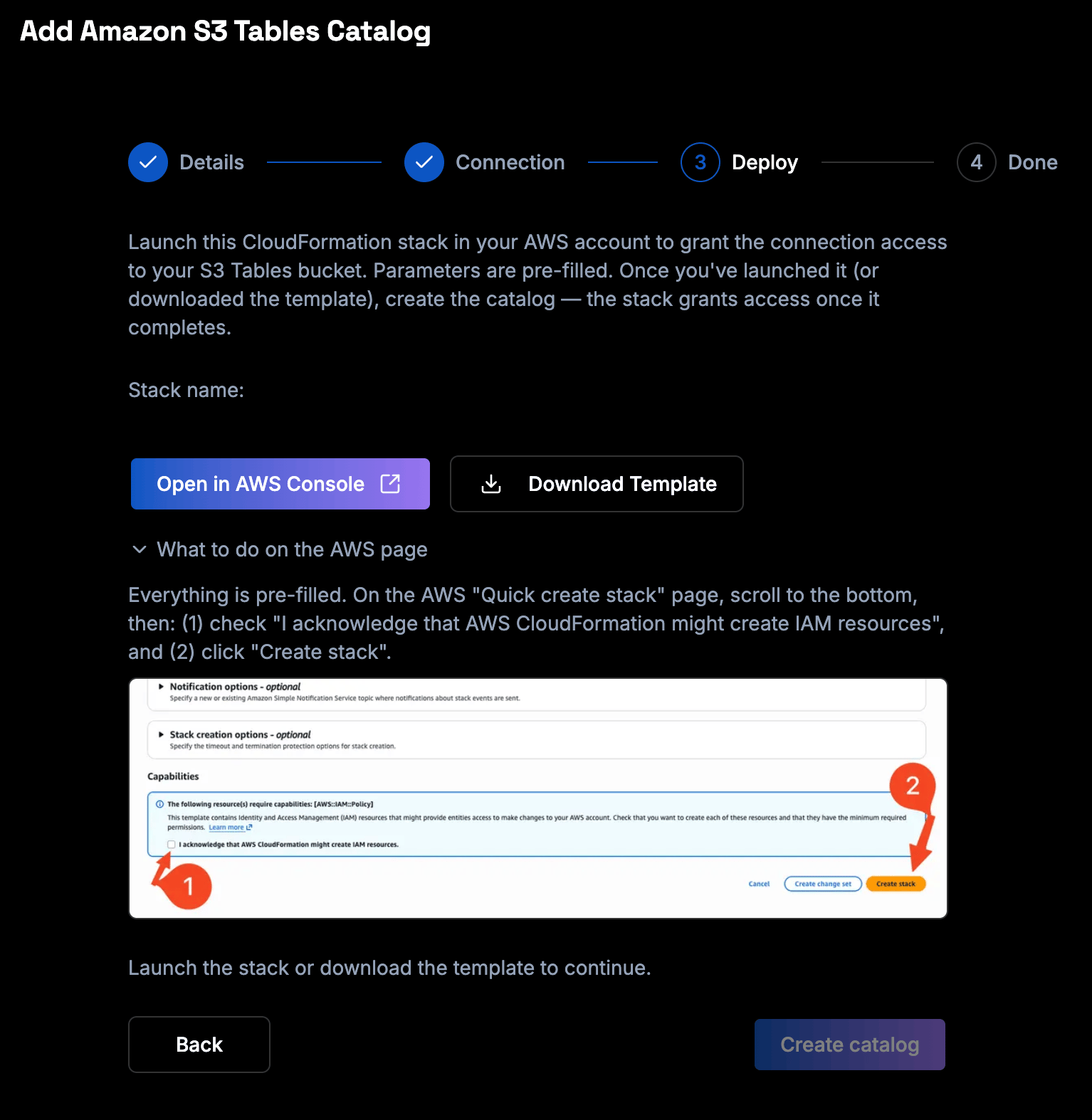
Step 3, Deploy, with What to do on the AWS page expanded.
Verify and finish
Next Steps
After you connect your S3 Tables catalog, you can query its tables from a Wherobots notebook. See Query Amazon S3 Tables Catalog in a Notebook for guidance and starter code.Limitations
Review the following caveats of the S3 Tables integration:- S3 Tables integration doesn’t support staged creates.
CREATE TABLEASSELECT(CTAS) /REPLACE TABLEASSELECT(RTAS) unsupported as S3 Tables rejects staged creates and will output"Stage-create is currently not supported"if attempted.
- S3 Tables integration doesn’t support reading or writing views.
- S3 Tables integration doesn’t support
ALTER TABLE … RENAME TO. - S3 Tables doesn’t support Iceberg V3
geometryorgeographycolumns.- You can create, write, and read Iceberg V3 tables (
'format-version' = '3') that use standard column types. Tables withvariantortimestamp_nscolumns aren’t supported. - S3 Tables rejects a table with a
geometryorgeographycolumn when it’s created, withMalformed request: The specified metadata is not valid.
- You can create, write, and read Iceberg V3 tables (
- Store geometries as WKB in a
binarycolumn.-
Write geometries into a
binarycolumn withST_AsBinary(), and decode them on read withST_GeomFromWKB(). -
WKB doesn’t carry an SRID, so decoded geometries have SRID 0. Set the SRID again with
ST_SetSRID()when you read them, using the SRID of your source data. The example below uses4326(WGS 84); replace it if your data uses a different coordinate reference system.Write and read geometries as WKB in an S3 Tables table -
If only Wherobots reads the table, you can keep the SRID in the stored bytes instead: write with
ST_AsEWKB()and read withST_GeomFromEWKB(), which returns each geometry with its original SRID, so noST_SetSRID()step is needed. EWKB is a PostGIS extension of WKB, so other engines that read the same table may expect standard WKB and fail to decode it.
-
Write geometries into a
DROP TABLE/DROP NAMESPACE ... CASCADEfrom Spark is unsupported.-
The integration can’t currently drop tables from Spark. Both
DROP TABLEandDROP TABLE ... PURGEfail withS3 Tables only supports dropping tables with purge enabled. -
Delete the table with the native S3 Tables API instead:
You can also delete the table from the AWS console under S3 → Table buckets, or with theDelete an S3 Tables table with the AWS CLI
boto3s3tablesclient’sdelete_tablemethod. -
DROP NAMESPACEfrom Spark works once the namespace is empty.CASCADEfails because Spark tries to drop each table first — delete the tables with the S3 Tables API, then drop the namespace from Spark or withaws s3tables delete-namespace.
-
The integration can’t currently drop tables from Spark. Both