

Benefits
The Workload History section of Wherobots Cloud allows you to view all executed workloads within your Wherobots Organization and manage job runs.Visualize resource consumption
Visualize resource consumption
Monitor Notebooks, Job Runs, and SQL Sessions to understand how resources are being used across your organization.
Identify usage patterns and trends
Identify usage patterns and trends
Spot trends for capacity planning and optimization by reviewing historical workload activity.
Track quota usage
Track quota usage
Stay aware of your organization’s quota consumption to avoid hitting computational limits.
Investigate usage spikes
Investigate usage spikes
Pinpoint the source of unexpected resource usage and analyze spikes in activity.
Analyze individual activity
Analyze individual activity
Review activity by user or service principal to understand contributions and workload distribution.
Make informed decisions about resource allocation and cost optimization
Make informed decisions about resource allocation and cost optimization
Use workload insights to guide resource allocation and optimize costs for your organization.
Before you start
Before using this feature, ensure that you have the following required resources:- An Admin or User Account within a Professional or Enterprise Edition Organization. For more information, see Create a Wherobots Account.
View Notebook, Job Run, and SQL Session workloads
For insight into your workload trends and individual Job Runs, go to Workload History in the left sidebar of Wherobots Cloud.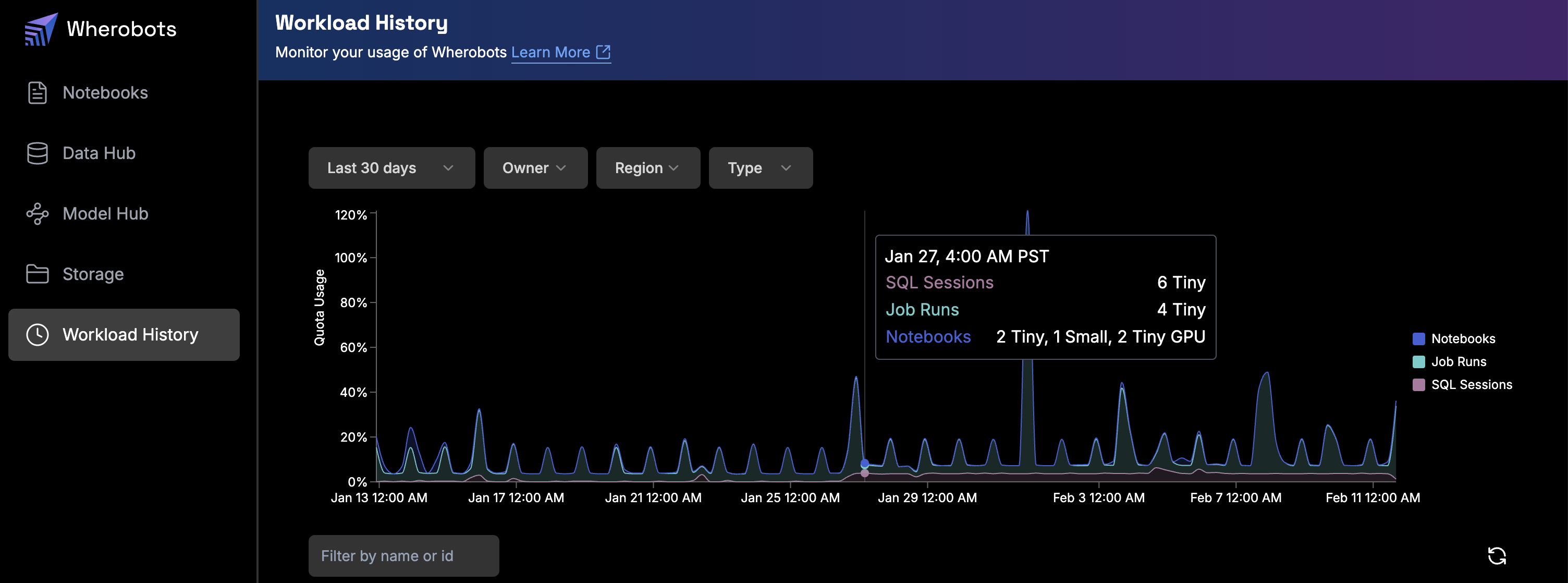
Workload history overview
Workload History provides two main views to analyze your workloads: Chart and Table.Chart view
In chart view, you can see an overview of all your workloads, including Notebooks, Job Runs, and SQL Sessions. The chart displays quota usage as a percentage of your organization’s total computing power over time. In Wherobots Cloud, go to Workload History. The chart displays Quota Usage as a percentage on the y-axis over the selected time range on the x-axis. Each area on the chart is color-coded by workload type: The legend on the right side of the chart identifies each workload type by color.Time Range Filter
Time Range Filter
View workloads from the last 24 hours, 7 days, or 30 days
Owner Filter
Owner Filter
Filter workloads by the Organization member or service principal that started them
Region Filter
Region Filter
Filter workloads by the AWS region where they ran (e.g., aws-us-west-2, aws-eu-west-1, aws-us-east-1)
Type Filter
Type Filter
Filter workloads by type: Notebooks, Job Runs, or SQL Sessions
- Notebooks (blue)
- Job Runs (purple)
- SQL Sessions (green)
Table view
The table view provides a detailed list of all workloads executed within your Wherobots Organization, along with key information about each workload.
Name
Name
The name or ID of the workload.
Owner
Owner
The entity that triggered the workload (Service Principal or User).
If your account is configured to the User role, and you use a service principal-managed API key generated by an Admin in your Wherobots Organization, actions are attributed to the service principal in Audit Logs, with the Admin shown as responsible solely for the API key creation.
Duration
Duration
The total duration of the workload.
Time Completed
Time Completed
The date and time when the workload completed, or “Running” status.
Region
Region
The AWS region where the workload executed.
Runtime
Runtime
The runtime size used (e.g., Tiny, Small, Medium, Large).
Cost ($)
Cost ($)
The estimated cost of the workload.
SUs
SUs
Spatial Units consumed by the workload so far. This information can be delayed by up to 20 minutes.
Filter workloads
To locate specific workloads, you can use multiple filters:- Navigate to Workload History.
- Use the Filter by name or id field to search for specific workloads.
- Apply filters for Time Range, Owner, Region, or Type as needed.
Manage Job Runs
In the Workload History view, click on any Job Run workload row to view more information about that specific execution. The detail page includes two tabs: Details and Logs.Details tab
The Details tab provides an overview of the Job Run’s configuration, runtime environment, and execution metadata so you can:- Review Spark version, runtime size, and environment details
- Verify scheduling, trigger source, and timeout configuration
- Understand when the Job Run started, ended, and how long it ran
Job Run Name
Job Run Name
The name of the Job Run, which is either user-defined or auto-generated.
Job Run ID
Job Run ID
Unique identifier for this specific Job Run.
Status
Status
Indicates if the Job Run is initializing (
Starting), in progress (Running), finished (Completed), or unable to be executed (Failed).Start Time
Start Time
Indicates when the Job Run was initiated.
End Time
End Time
Indicates when the Job Run terminated.
Duration
Duration
Indicates how much time elapsed between the Start Time and End Time.
Triggered By
Triggered By
The entity that triggered the Job Run (e.g., Airflow, user email).
Runtime
Runtime
The runtime size used for this Job Run (e.g., Tiny, Small, Medium, Large).
Runtime Version
Runtime Version
The version of the runtime environment used for this Job Run.
Timeout
Timeout
The maximum duration the Job Run is allowed to run before being automatically stopped, in seconds.
Region
Region
The AWS region where the Job Run executed. Different regions may have different performance characteristics and costs.
Python File
Python File
The URI of the Python file executed in this Job Run.
Environment
Environment
The Spark configuration details for this Job Run.
Cancel Button
Cancel Button
Consumption metrics
Each Job Run Details page specifies the consumption metrics and details associated with a specific workload execution, including the following:
Cost ($)
Cost ($)
The estimated cost of the workload execution.
Spatial Units Consumed
Spatial Units Consumed
Indicates the accumulated Spatial Unit Consumption for this workload.
Max CPU Utilization
Max CPU Utilization
Indicates the accumulated CPU usage for this workload.
Max Memory Utilization
Max Memory Utilization
Indicates the accumulated memory used for this workload.
Configuration information
Each Job Run Details page specifies the Configuration information associated with a specific workload execution, including the following:Runtime
Runtime
Indicates the size of the Runtime associated with the workload.
Timeout
Timeout
Specifies the maximum duration the workload is allowed to run before being automatically stopped, in seconds. The default is
3600.Region
Region
Specifies the compute region where the workload is being executed.
URI
URI
The location or path of the Python script being executed.
Logs tab
The Logs tab provides real-time access to execution logs for your Job Run including information about:- File downloads and uploads
- Spark submit commands
- Spark version and environment details
- Warnings and error messages
- Application execution progress
Job Run Name
Job Run Name
The name of the Job Run, which is either user-defined or auto-generated.
Job Run ID
Job Run ID
Unique identifier for this specific Job Run.
Status
Status
Indicates if the Job Run is initializing (
Starting), in progress (Running), finished (Completed), or unable to be executed (Failed).Spark UI
Spark UI
A link to the Spark UI for this Job Run.
Search Logs
Search Logs
Search through log entries using
Cmd/Ctrl + F.Log Timeline
Log Timeline
View timestamped log entries showing the execution progress.
Copy Logs
Copy Logs
Copy all log entries to clipboard.
Download Logs
Download Logs
Download the complete log file for offline analysis.
Compare workload performance
To compare workload performance with different runtime types:- Run a workload. For more information on initializing a job and runtime selection, see WherobotsRunOperator.
- Run that same workload again with either a larger or smaller runtime type.
-
Review the Detail pages for each executed Job Run to compare performance metrics, specifically:
- Duration
- Max CPU Utilization
- Max Memory Utilization
- Cost($)
- SUs (Spatial Units)
Cancel a workload
Wherobots cancels workloads based on your specification oftimeoutseconds in the Job Runs REST API Schema, which defaults to 3600, but you can also cancel a workload in Wherobots Cloud.
To cancel a workload within Wherobots Cloud, do the following:
- In Workload History, locate the Job Run you wish to cancel.
- Click on the Job Run to open its detail page.
- Click the Cancel button.
Limitations
The following limitations apply to the Workload History feature:90-day data retention
90-day data retention
Workload history data, including Spatial Unit Consumption, Max CPU Utilization, and Max Memory Utilization metrics, is only kept for 90 days.
Slightly delayed cost and SU data
Slightly delayed cost and SU data
Spatial Unit Consumption and Cost can take several minutes to display on a Job Run’s Detail page.
Quota usage is percentage-based
Quota usage is percentage-based
The chart displays quota usage as a percentage of your organization’s total computing power.